Audio & Video Learning: An Oversold Promise or the Future of Corporate Training Content
The article argues that traditional, screen-heavy training content is failing fatigued desk and deskless workers, and makes the case for AI-powered, audio-first and micro-video multimodal learning - via an Activation Layer - to boost access, engagement, and measurable impact.
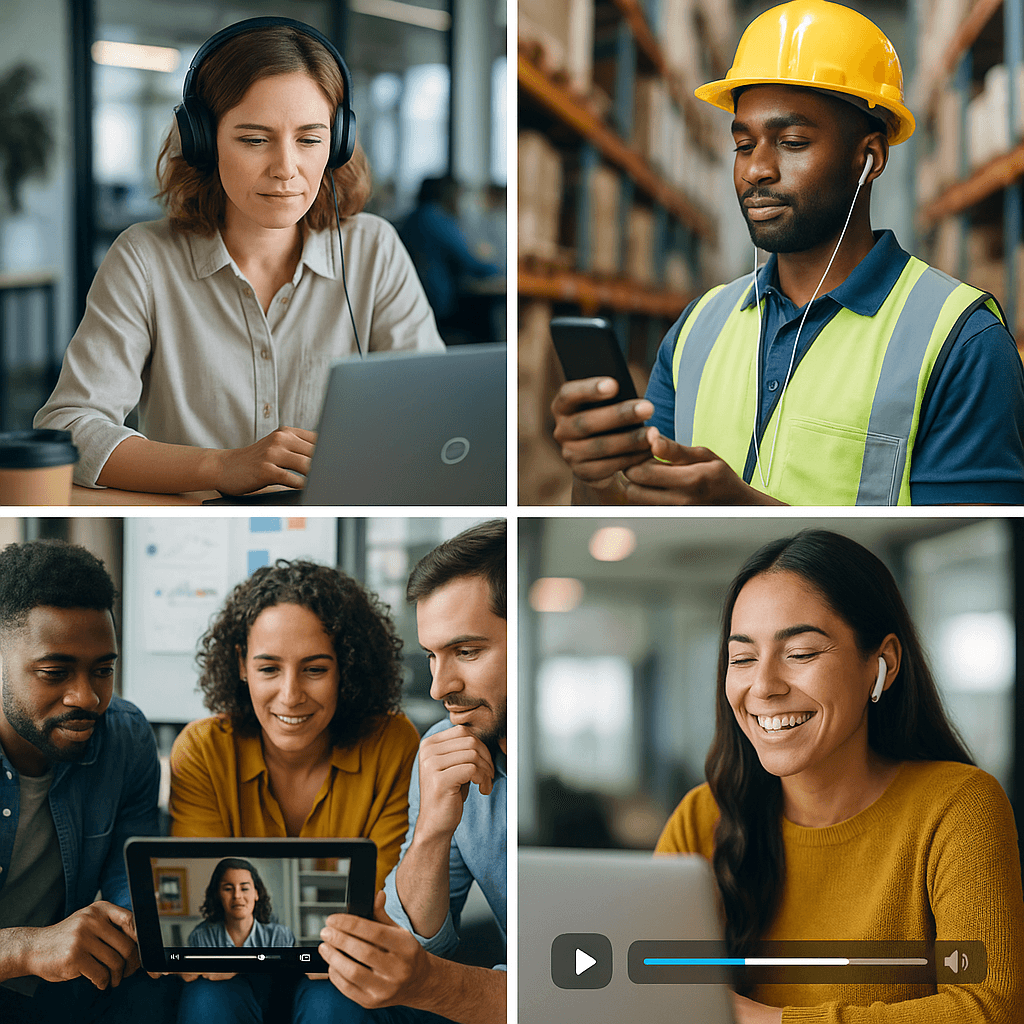
Employees now spend, on average, a staggering 97 hours per week looking at screens. This is not just a wellness statistic; it is a fundamental business crisis. This level of saturation has created a powerful physiological barrier to the primary delivery method for corporate training content: the screen.
For decades, Learning and Development (L&D) has relied on screen-based e-learning. Yet, today, L&D departments find themselves in a crisis of engagement, caught between two colliding forces. First, their "desk-based" audience is suffering from debilitating digital fatigue, where the request to take another 30-minute mandatory module is met with physical and mental resistance.
Second, the "deskless" workforce - 80% of global workers in retail, logistics, and manufacturing -has been almost completely ignored, lacking the access and time for traditional e-learning.
The old model of passive, one-size-fits-all training content is failing. This has led many to champion audio and video as the solution, but are these new formats just another oversold promise? Or do they represent an essential strategic pivot that L&D must make to survive, engage employees, and deliver measurable business value?
As explored in our new White Paper, the answer lies not in just using these formats, but in how they are intelligently generated, delivered, and measured.
The "Check-the-Box" Trap: Why Traditional Training Content Fails
Before implementing new solutions, it is critical to understand the depth of the current failure. The status quo of corporate training, particularly for compliance, is defined by a "check-the-box" culture, where success is measured by completion rates, not comprehension or application.
What the Data Reveals
The data on this failure is damning. A landmark Gallup analysis found that:
Fewer than one in four employees (23%) who participated in compliance or ethics training would rate that training as "excellent".
Only one in ten "strongly agree" they learned something that changed how they do their work.
Most critically, only 11% "strongly agree" their coworkers apply what they learned in compliance training to their work every day.
Overall, the training content is "uninspiring, unmemorable, or irrelevant" and leads directly to massive corporate risk, including regulatory fines and reputational damage.
This motivational crisis is now colliding with the physiological crisis of screen fatigue. The 97-hour per week screen-time average, identified in the 2025 Workplace Vision Health Report, is having a direct impact on business operations.
68% of employees now suffer from digital eye strain.
59% of employees report this eye strain directly worsens their productivity and effectiveness at work.
55% report a negative impact on their ability to focus, and 42% on their mental health.
The Reality: Training Content & Multitasking
When an L&D department asks a screen-fatigued employee to take a screen-based training module, they are no longer just competing for time; they are competing with a biological self-preservation response.
This dynamic creates what can be called "shadow engagement." Employees are pressured to "check the box" but are physiologically and motivationally unwilling to engage. The result?
2025 Moodle data reveals that 46% of employees let training videos play while they multitask or speed them up. Another 14% simply mute the video or click through quizzes without participating. The often-cited statistic that viewers retain 95% of a video's message is completely irrelevant if nearly half the audience is actively ignoring the content.
The Advantages of Audio Learning in Corporate L&D
Audio-first learning is not just a new trend. This type of training content is the most direct strategic solution to the twin crises of screen fatigue and the "check-the-box" culture.
The Current Market
First, it meets a massive, unserved market demand. In our White Paper, we reveal a profound "Audio Gap": 92% of employees believe audio is an effective way to learn, yet 86% of companies provide no audio learning options.
This is a serious market failure. Further research confirms this, with 97% of employees stating they want audio learning to be made available alongside other formats.
Companies are failing to capture learning behaviors that employees already exhibit. 74% of people already use podcasts to learn, and nearly 60% of employees are "pursuing learning outside work" through podcasts and videos. By not providing this content in-house, organizations are ceding control of their employees' development to external, unvetted sources.
Second, audio is the only format that directly solves the 97-hour screen-fatigue problem. It allows learning "without disrupting the day". It complements the modern workday by fitting into "the nooks and crannies" - the commute, a walk, or routine administrative tasks - rather than competing for a new, dedicated block of visual attention.
Reaching the “Overlooked Majority”
Third, and most critically, audio is the key to reaching the "overlooked majority." The 2.7 billion people in the deskless workforce make up 80% of the global workforce. This majority, however, receives a scant 1% of all enterprise software investment. This neglect has created a deep cultural and retention crisis:
60% of deskless workers are unhappy with their current tech.
51% feel "regarded as expendable" by their employer.
49% feel a "cultural divide" between themselves and corporate, desk-based colleagues.
Traditional e-learning is logistically impossible for this group, 62% of whom have limited or no access to a PC during their workday and 83% of whom do not have a company email address. But they have phones. Audio-first, mobile-delivered training content is the only viable, scalable L&D solution. It is not just a training tool; it is a cultural integration tool that directly combats the "expendable" feeling and proves the company is investing in all of its people.
But does it work? While some long-cited figures, like the NTL "Learning Pyramid," have been thoroughly debunked as "rubbish", actual research shows that comprehension between text (53% accuracy) and audio (55% accuracy) is very similar.
The more important metric, however, is application. In controlled corporate pilots, 87% of employees reported that audio training impacted their decision-making and behaviors - an enormous improvement over the 11% application rate for traditional training.
Implementing Audio via Oromis’ Activation Layer
The primary barrier to adopting an audio-first strategy is not desire, but production. 33% of L&D teams cite a "lack of resources and personnel" as their top challenge. They simply do not have the time or budget to manually script, record, and produce a full library of audio training content.
This is the bottleneck that intelligent platforms are designed to solve. An "Activation Layer," as conceptualized by Oromis, functions as a content refinery. It uses AI to ingest dense, low-value "dead" content - such as a 50-page, text-heavy compliance policy - and automatically refines it into high-value, "science-backed snackable courses" and "digestible, audio-first compliance briefs".
Where AI Comes In
This process is powered by two key AI technologies:
Generative AI: This technology can "drastically reduce" content creation time from weeks to hours by automatically generating scripts, summaries, and realistic scenarios based on the source material.
AI Text-to-Speech (TTS): Advanced AI voice synthesis platforms then "turn text into natural-sounding speech instantly," solving the audio production bottleneck at near-zero marginal cost.
How the Activation Layer Improves Your Training Content
An Activation Layer then manages the entire compliance lifecycle: it generates the micro-briefs, delivers them to employees where they already work (such as via Slack or Teams), and tracks comprehension with quizzes, providing "immutable audit logs" for regulators. This system is designed to move L&D "From Policy to Proof" in hours, not weeks.
While the White Paper notes the potential of using a "cloned voice of a leader" to sound familiar , this is a high-risk feature. It can "scale their reach" , but it also risks being perceived as an "uncanny valley" or a "deepfake" , which could shatter the very trust it aims to leverage.
A more robust strategy may be to use high-quality, transparent artificial voices, building trust on utility and efficiency rather than personality.
Mixing Audio and Video Learning: A Multimodal Toolkit for Every Style and Need
Audio-first is the strategic wedge to solve the immediate problems of fatigue and access. The ultimate goal, however, is a complete multimodal toolkit. Audio remains unmatched for knowledge-in-motion, but as the White Paper argues, "certain concepts are best taught visually". Research confirms that blending visual, auditory, and kinesthetic learning engages more senses and can enhance retention.
How Can Video Improve Corporate Training?
The key is to avoid the trap of long-form, passive video. The Oromis future roadmap, which serves as a powerful case example, rightly focuses on "short-form and microlearning modules". This is critical. The data on microlearning is definitive:
Completion Rates: Microlearning (under 10 minutes) achieves ~80% completion rates, compared to ~20% for traditional, long-form e-learning courses.
Retention: These short modules demonstrate 50% higher retention rates than traditional formats.
Taking Your Training Content to the Next Level
The future-state features outlined in our White Paper provide a perfect case study of a system built to solve the failures of old L&D:
AI "Slide-to-Video Conversion": This feature is the video equivalent of the audio refinery. It empowers L&D teams to take the thousands of "dead" PowerPoint decks sitting on company servers and instantly activate them into narrated, visually dynamic training videos. This solves the L&D resource bottleneck at scale.
"In-Video Checkpoints and Smart Quizzing": This is the direct antidote to passive consumption. By embedding mandatory knowledge checks and reflection prompts, the platform forces active engagement. This feature is designed specifically to solve for the 46% of employees who let videos play in the background, shifting the metric from "Video Played" to "Concept Understood."
"Integrated Performance Feedback Loops": This is the "holy grail" of L&D. The system is designed to "correlate video completion and engagement data with post-training performance metrics". This is the feature that finally breaks the "check-the-box" culture. It provides the data for L&D leaders to answer the C-suite's critical question: "How did this training content mitigate risk and improve performance?".
From Passive Content to Active Intelligence
The traditional L&D model, built on passive, screen-heavy training content, is broken. It is failing the 23% of employees who find it "excellent", the 59% whose productivity is hampered by screen fatigue, and the 80% of deskless workers it never even reaches.
The future of corporate training content is not one-size-fits-all. It is a flexible, intelligent, and multimodal mix of audio-first microlearning for on-the-go knowledge and interactive micro-video for complex visual concepts.
Executing this shift requires more than just new formats; it requires a new platform and a new playbook. L&D leaders must:
Stop Competing for Screen Time: Pivot to an audio-first strategy to leverage employee "dead time" during commutes and walks, effectively combating the 97-hour screen-fatigue crisis.
Engage the "Overlooked Majority": Use mobile-first audio to finally reach the 80% of your workforce that is deskless, turning training into a powerful retention and inclusion tool.
Weaponize "Dead" Content with AI: Adopt an "Activation Layer" to transform your existing, dense policies and static slide decks into an arsenal of "snackable" audio and video assets.
Measure Performance, Not Completion: Abolish the "check-the-box" by investing in platforms that provide "smart quizzing" and "integrated performance feedback loops" to prove measurable, real-world business impact.
In this article, we have only scratched the surface when it comes to audio and video training content in corporate learning. To see the complete data and learn how to build your own AI-driven multimodal toolkit, download the full White Paper today.